Free
$0
- One language
- Logging and the timer
- A daily goal with a weekly recap
- Streaks, stats and the map
- All your history, with CSV export
LangTrack is a small language tracker for the hours you actually put in: the YouTube video, the anime episode, the Anki reviews, the podcast on the bus. Log each one in a tap or two, and see how far you are from the level you're aiming for.
Sign up with Google or email · No card · Free for one language
Evening
Mei 👋
12 days strong. You're past the hard part.
🎯Your goals
This week4h 12m
Most of the time you spend on a language isn't in a course. It's YouTube, anime, Dreaming Spanish, a podcast, a show on Netflix, a deck in Anki. LangTrack logs each session with its source, activity and language, so immersion counts as real hours instead of a vague feeling.
You log it yourself; LangTrack doesn't read your watch history. That keeps it honest: an episode you half-listened to while cooking is yours to count or not.
| Source | Activity | Language | Minutes |
|---|---|---|---|
| YouTube | Watching | Spanish | 20 min |
| Dreaming Spanish | Watching | Spanish | 45 min |
| Anime | Watching | Japanese | 24 min |
| Anki | Vocabulary | Japanese | 15 min |
| Podcast | Listening | Spanish | 30 min |
| Today | 2h 14m | ||
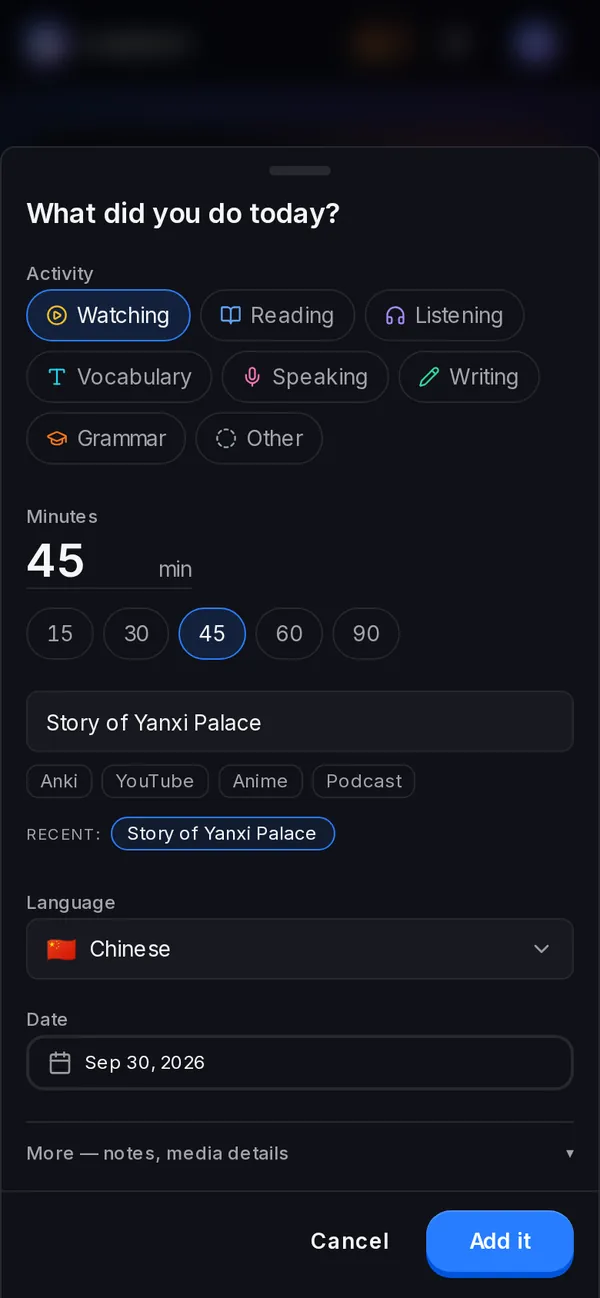
LangTrack looks at what you log most often and turns it into shortcuts: YouTube for 20 minutes, an anime episode, your Anki session. Tap one and it's logged, with an undo if you didn't mean it.
For anything else, pick the activity, language and minutes, or start the timer and stop it when you're done.
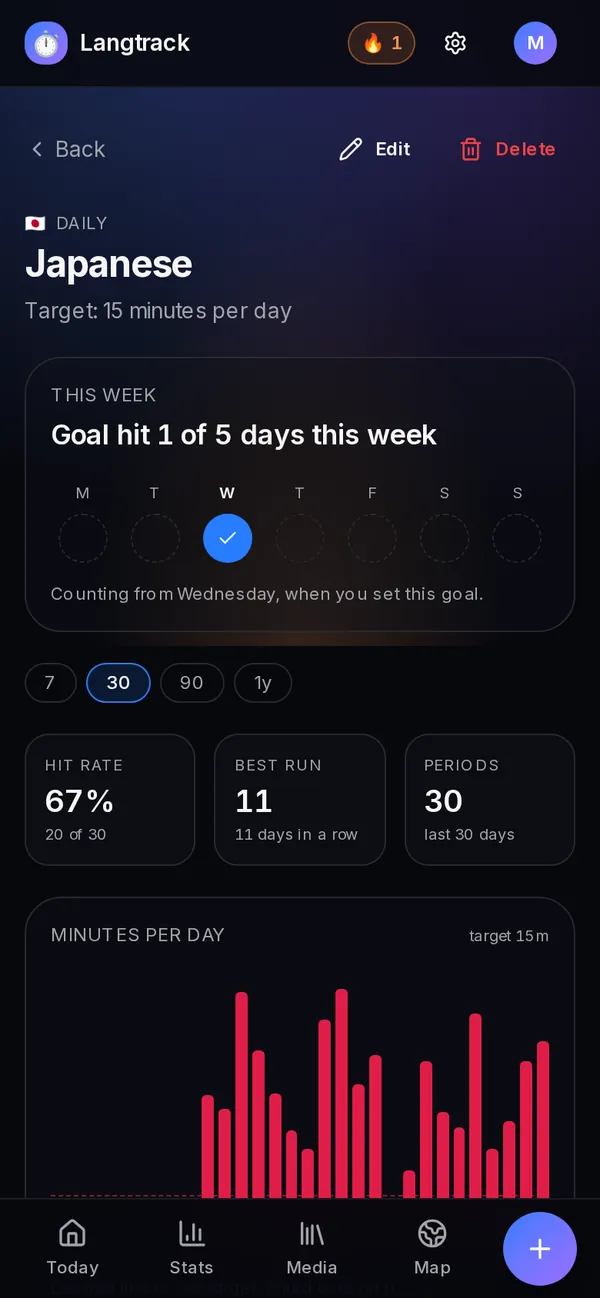
Set a level goal, say B2 in Spanish, and LangTrack estimates the hours it takes from FSI-based figures, adjusted for your native language and the other languages you speak. Then it shows what's left and, at your pace over the last four weeks, roughly when you'll get there.
The estimate is rough on purpose. Your own logged hours are the better number. The FSI language list: hours for every language
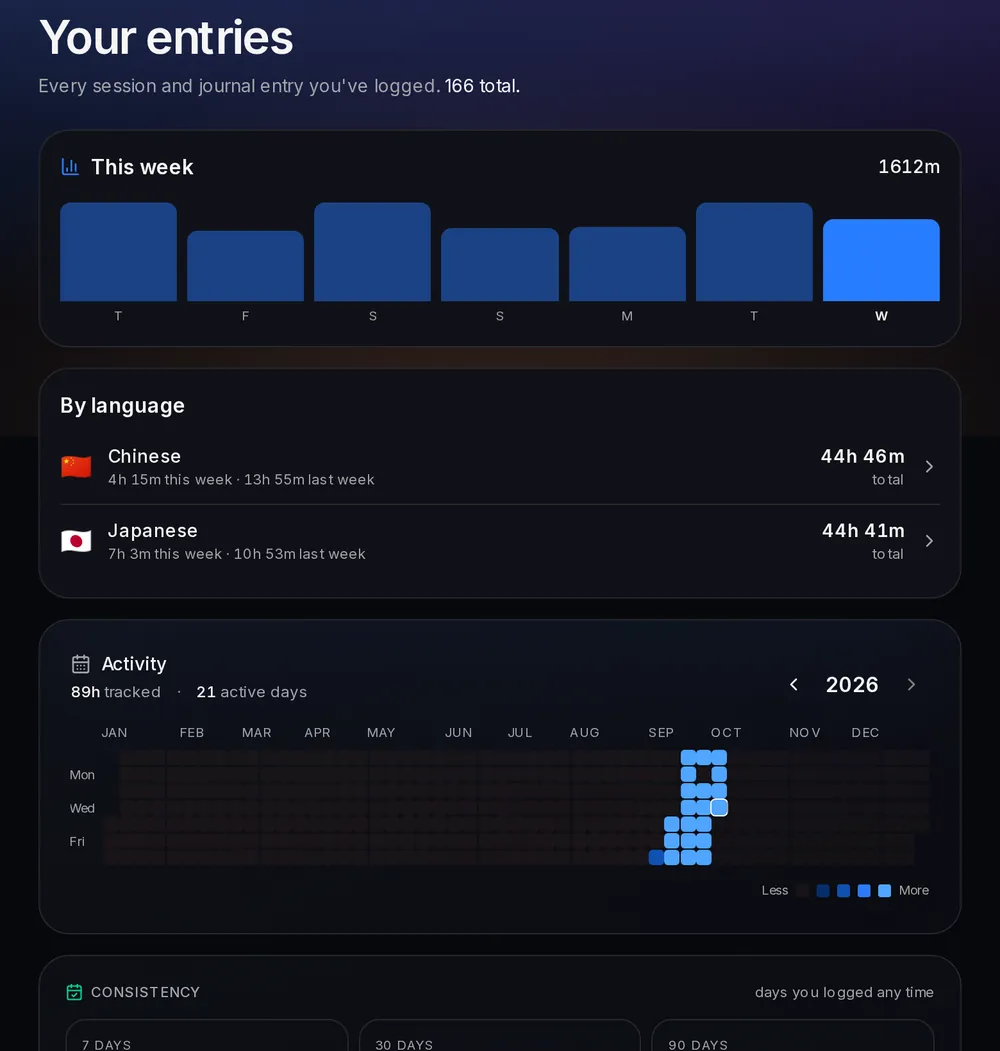
Already been learning for a year? Enter the hours you put in before LangTrack as one total per language, including your Dreaming Spanish hours. Your history starts where you actually are, not at zero.
Then the Stats page splits your time by language, puts this week next to last week and lays the year out as a grid of days.
All four can work. They're good at different things, and the honest answer depends on how much setup you'll put up with.
| Feature | LangTrack | Spreadsheet | Duolingo stats | Notion template |
|---|---|---|---|---|
| Counts time outside one app | Yes: any source, activity and language | Yes, if you type it in | No: only what you do in Duolingo | Yes, if you type it in |
| Logging a session | One tap for your usual sources, a few seconds otherwise, or a timer | Open the sheet, find the row, type the date and minutes | Automatic, for Duolingo lessons | Add a database entry and fill in the fields |
| Hours by language and activity | Built in, with weekly and yearly views | With a pivot table you build | XP and lessons, not hours across your study | With views and formulas you build |
| Daily goal and streak | Yes, with a weekly recap | Possible with formulas | Yes, for Duolingo practice | Possible with formulas |
| Hours to a target level | Estimate with a finish date at your pace | If you build it | Course progress, not hours to a level | If you build it |
| Bringing in past hours | One "before LangTrack" total per language | Paste rows in | Not applicable | CSV import |
| Setup | Sign in and pick a language | Build it or copy a template | None | Duplicate a template, then adjust it |
| Cost | Free for one language; Pro US$2.99 a month | Free | Free, with paid plans | Free plan available |
Duolingo's numbers are good at what they measure, which is Duolingo. A spreadsheet or Notion page can do anything if you'll maintain it. LangTrack is for when you want the hours counted with as little effort as possible. Language tracker vs spreadsheet: the longer version
Free covers one language, keeps all your history and doesn't run out. Pro is for people learning more than one.
$0
US$2.99 a month
or US$29.99 a year (about US$2.50 a month) Save 16%
Prices are in US dollars. Pro is bought inside the app.
Something else? Write to us.
A language learning tracker is a log of the time you spend on a language: what you did, in which language and for how long. Over weeks it shows your total hours, how they split between activities like watching, reading and vocabulary, and whether you're keeping a steady pace.
Yes. Each entry has a source, so YouTube, an anime episode, Dreaming Spanish, a podcast or Anki each count as their own hours. LangTrack doesn't connect to those services; you log the session, and your usual ones become one-tap shortcuts.
Yes for one language, with logging, the timer, a daily goal, streaks, stats, the map and all your history. Pro costs US$2.99 a month or US$29.99 a year (about US$2.50 a month) and adds unlimited languages, the media library and streak repair.
It starts from figures based on the U.S. Foreign Service Institute's estimates for English speakers, adjusts them for your native language and the other languages you know, and compares the result with the hours you've logged. The finish date uses your average pace over the last four weeks. Treat it as a rough guide.
Yes. Enter one total per language for everything you did before LangTrack. Those hours count towards your totals and level goals.
No. It's a web app at app.langtrack.app that works in the browser on phones, tablets and computers.
Log today's YouTube, anime or Anki session. It takes a tap, and the hours start adding up from there.
Start tracking — it's free